
Kenna - King Of Trees
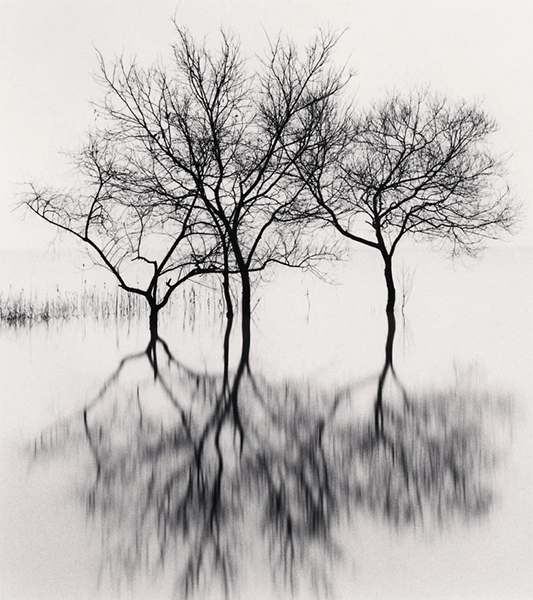
Artwork credit – Michael Kenna – Contented Trees
Michael Kenna an acclaimed English-born photographer is famous for his minimalist, ethereal, black-and-white images of trees and landscapes. In an article Legendary Photographers: 10 lessons we can learn from Michael Kenna penned by Vivek Verma we find out more about Kenna’s photographic style that is emotionally evocative rather than descriptive. A person who finds fulfillment in the continuous act of creating, staying curious and open to what unfolds, Kenna is profoundly inspired by Japanese art, philosophy, and visual culture – particularly its serenity, simplicity, and balance. His aesthetic embodies concepts like wabi-sabi and ma, often reflected in his use of emptiness and restraint. With the use of elements like fog, mist and rain, Kenna strips away visual clutter and distraction to keep his images minimalistic. For Kenna, photography is not an act of taking or acquiring; it’s about forming a relationship with the subject, especially in landscapes. Kenna believes technical proficiency should become invisible in the creative process. I`m always chasing the light but I`m not convinced there is a “best light or right light” I think a landscape photographer should be flexible and spontaneous and I aspire to be able to work in all lights and all conditions. Click on the link below to read the full article and find out more about Michael Kenna.
The Gray Tree
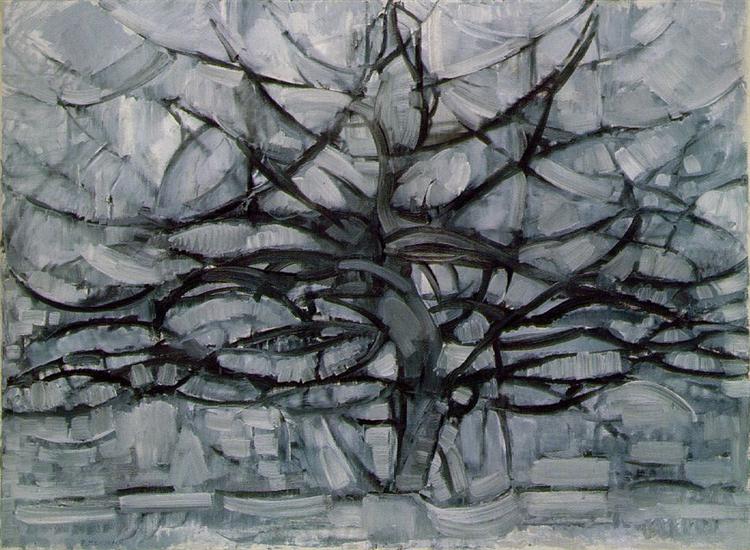
Piet Mondrian also experimented with trees!! This piece contains interlocking blocks, which form together in the shape of a tree. But unlike cubist artists from whom he took his cue, such as Picasso and Georges Braque, Mondrian had yet to merge his artistic style with his spiritual pursuits, and as such this was only one of a few of such cubist experiments. Mondrian still had a few years to go experimenting with other art forms before he would begin to find his real voice as an artist, although one could argue that his style was ever-changing, culminating in his masterpieces in his later years of life. Gray Tree, an oil painting made in 1911 is exhibited at The Hague.
The Mulberry Tree
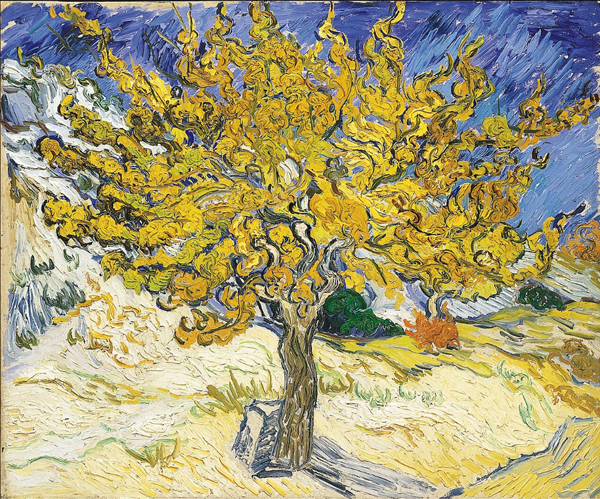
Vincent Van Gogh found a deep connection with the expressive qualities of trees. He would view them with human characteristics. Van Gogh painted The Mulberry Tree in October of 1889 less than a year before he would die. Like most of his art, it was done during a period of highs and lows painted during a time of great self-awareness and yet surrounded by chaos. The painting shows his knowledge of color theory, his awareness of the modern direction of painting, and his place in the world. No matter what was happening in his life, whether he was living in a house with a friend, or a patient in a mental hospital, all Van Gogh could do was carry on and paint.
Paul Klee And A Tree
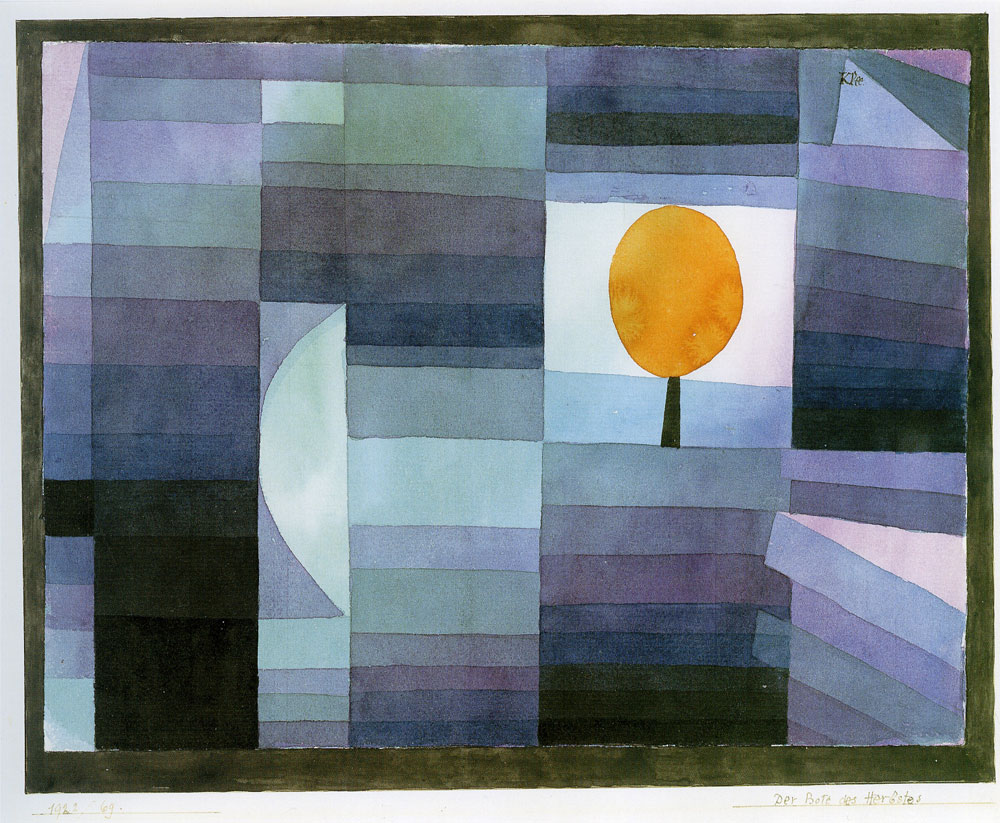
Paul Klee a Swiss-German artist was known for his unique, playful style that combined abstraction, musicality, and childlike simplicity with deep intellectual depth. Klee’s artistic breakthrough came in 1914 when he briefly visited Tunisia and was impressed by the quality of the light there. He wrote, Color has taken possession of me; no longer do I have to chase after it, I know that it has hold of me forever… Color and I are one. I am a painter. Klee has been variously associated with Expressionism, Cubism, Futurism, Surrealism, and Abstraction, but his pictures are difficult to classify. He generally worked in isolation from his peers, and interpreted new art trends in his own way. He was inventive in his methods and technique and worked in many different media: oils, watercolours, ink, pastel, etching, and others. He often combined them into one work. Using many different materials – canvas, burlap, muslin, linen, gauze, cardboard, metal foils, fabric, wallpaper, and newsprint, Klee also employed spray paint, knife application, stamping, glazing, and impasto, and mixed media such as oil with watercolor, watercolor with pen and India ink, and oil with tempera. His Harbinger of Autumn above was watercolour and pencil on paper bordered with watercolour and pen, mounted on card…and yes he loved trees too!
Tim Burton
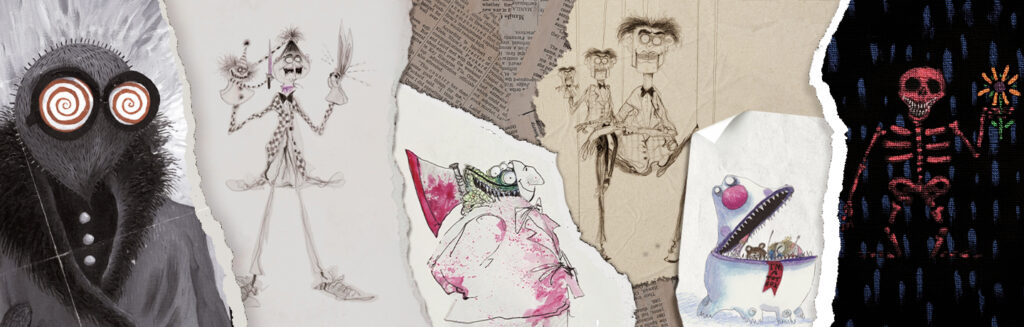
Tim Burton’s relationship with trees is a defining visual signature of his cinematic style, characterized by twisted, skeletal, and gothic shapes that reflect the inner psychology of his lonely outsiders. Burton, an American filmmaker, is most famous for his iconic gothic-whimsical films, concept sketches, illustrations, and sculptures that define his dark pop-surrealist aesthetic. His work blends horror, fantasy, and surreal imagery. His signature visual style often features gnarled, spiral, or claw-like trees, tilted houses, tortuous street – all functioning as extensions of his characters’ psyches. What emerges is a language of the grotesque and the macabre, organically woven into his visual narrative. This deliberate distortion of bodies and spaces establishes a clear parallel with German Expressionism and iconic works such as Munch’s The Scream: twisted geometry, disproportionate faces, anguished figures – all meant to convey emotion rather than depict reality. Like the expressionists, Burton uses exaggeration to communicate the inner world and, in doing so, grants darkness a new tenderness.
Tim Burton: The Labyrinth, an exhibition currently in Mexico City, is an experience that restores the viewer’s ability to wander through the unusual from within. Tim Burton: The Labyrinth is more than a visual homage; it invites us to rethink how we perceive what feels strange. In every room, deformity ceases to be an aesthetic flaw and becomes a collection of emotions, misunderstandings, and vulnerabilities. The viewer does not merely observe, they inhabit Burton’s world, entering a constant dialogue between melancholy, fantasy, and Mexico City’s own celebration of death. By the end of the journey, one leaves with the sensation of having traversed a labyrinth of ideas and feelings, where the somber becomes familiar, the bizarre becomes beautiful, and the experience redefines what we mean by “monster.”
Click on the link below to hear Tim interviewed
8 Minutes With Trees
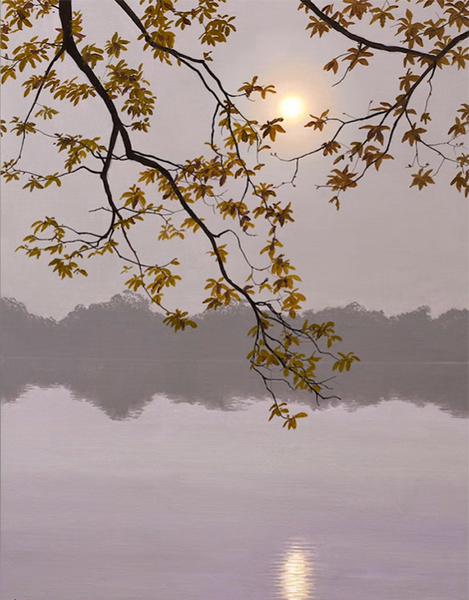
LYou can spend 8 mins with Michael James Smith and watch how he creates the above artwork…and yes it has trees as a feature!! Michael is a renowned British landscape artist and oil painting instructor known for his highly detailed, photorealistic depictions of the UK countryside. He is the son of the renowned British landscape painter, David Smith. Michael studied Fine Art at Southend College and at the age of 18, became a professional artist, sharing the same studio as his father. Inspired by the British countryside Michael is one of the UK’s leading landscape artists and holds a distinctive style, his work is quite photorealistic and embodies detail, observational accuracy and vivid natural colours. Michael’s oil paintings are highly sought-after and collected throughout the world. Established in 2017, his online art school provides step-by-step video tutorials for artists ranging from absolute beginners to advanced painters.
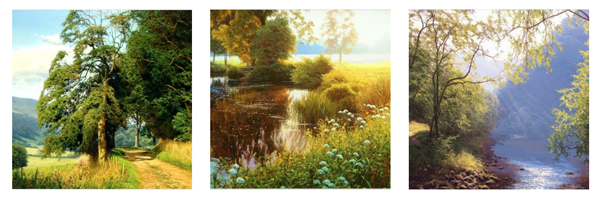
Finding Minimalism

Anthony Lamb is a British-born fine art photographer who splits his time between the United Kingdom and the United Arab Emirates. His interest in photography was a combination of several influences. When he was young, he was lucky enough to travel to some extraordinary locations such as the European Alps, North Africa and the Scottish Highlands. These visits fuelled Anthony’s love of the wilderness and created an appreciation for uninhabited areas, places where solitary embodiment was possible. Combining his fascination with the natural environment and his passion for minimalist art and design, inspired Anthony to pick up a camera in 2003. His intention; to document his outdoor experiences using a simplistic interpretation of the landscape. In his photographs, negative space and an ethereal aesthetic provide the viewer with a sense of serenity and calm, interpreting the emotions of the moments captured. His post-production style offers pastel expressionism to soothe the soul further. Incorporating a minimalistic approach within his photography and drawn to water and open space; you will see these narratives in many of his photographs. My wish is to offer different frames of reference that transport you to a place suspended between reality and your imagination.
In the video below Anthony Lamb explores the art of reducing complex coastal landscapes to their essential forms on the Isle of Lewis and Harris. The video demonstrates how to use composition, lighting, and stillness to create emotionally resonant, minimalist imagery.
Avast there ye landlubbers!!

The crew o’ Print Art Pirates, wish ye a very ‘appy international Talk Like A Pirates day!
Raise the Jolly Roger! Today we write legends in the brine and blood!